MOC Information System
Created: 2022-10-01
Basically, information system is any devices that we use to transfer, get or receive informations such as search engine, messenger, youtube. For the company, they might use excel, word, email etc...
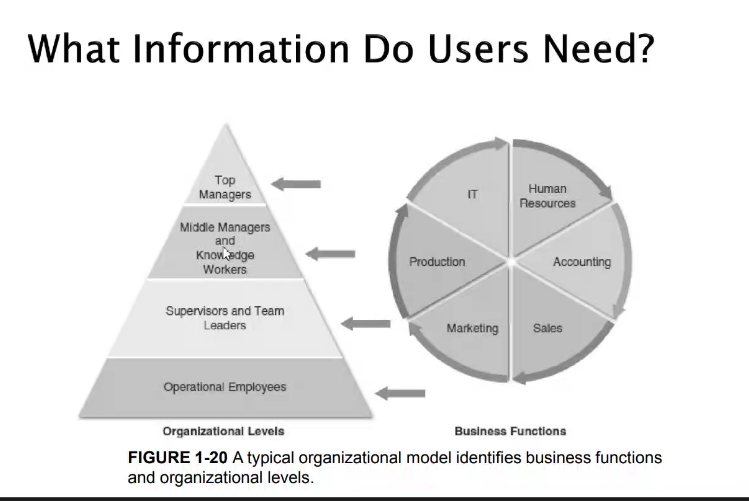
Users on an organization:
- Top Managers (President)
- Middle Managers and Knowledge Workers (School Coordinator)
- Supervisors and Team Leaders (Dean)
- Operational Employees (Teachers)
What information do they need?
Top Managers
Develop Strategic Plans (like 5 year plan)
Needs information on economic forecasts, technology trends, competitive threats and governmental issue.
Middle Managers and Knowledge Workers
Provide direction, necessary resources, and performance feedback to supervisors and team leaders
Needs more detailed information than top managers
Supervisors and Team Leaders
Oversee operational employees and carry out day-to-day functions
Need decision support such as:
- information,
- knowledge management systems
- user productivity systems
Operational Employees
Rely on Transaction Processing Systems (TPS) to enter and receive data they need to perform their jobs
Need decisions made by supervisors to handle tasks.
Radio frequency identification (RFID) tracks items.
The barcode scanner things
Require systems that combine transaction processing, business support, knowledge management, and user productivity features. - System Integration
Business Model Canvas
life-cycle development or rapid application development
The same methods are used by software vendors, which need to provide more general, customizable systems. Large organizational systems, such as enterprise systems, are generally developed and maintained through a systematic process, known as a system life cycle, which consists of six stages: feasibility study, system analysis, system design, programming and testing, installation, and operation and maintenance. The first five stages are system development proper, and the last stage is the long-term exploitation. Following a period of use (with maintenance as needed), the information system may be either phased out or upgraded. In the case of a major upgrade, the system enters another development life cycle.